I found robotics by accident at fourteen.
At the back of my Earth Science classroom, another student was working on what looked to me like a blue motherboard with wires coming out of it. His name was Sherwin, the lead programmer for the school’s robotics team. I asked what he was working on. He told me the team was meeting after class and said I should stay.
I did. For the next four years, robotics became the center of my life.
Sherwin taught me Python at the local park. On bus rides, we didn’t have games on our phones, we had Sherwin. He would make up choose your own adventure games on the spot and somehow keep all of us entertained. He was the first student in high school I really looked up to, and I took pride in eventually holding the same position he had when I met him: lead programmer.
Our coach, Dr. Charles Ries, was also my Earth Science teacher.
During build season, I started sleeping on the living room couch because its window looked out toward the high school parking lot. I would set an alarm for six, shower, and wait for his car to pull in. Student IDs did not open the doors until 7:30, but if I caught him walking in from the parking lot, I could follow him inside and buy myself another hour to debug drive controls before school.
Once it became clear that I was going to keep showing up, he started bringing breakfast. On his hour plus commute to the high school, he would stop at a bagel shop to pick up my favorite order: a cinnamon bagel with blueberry cream cheese. Every morning he would hand me a brown bag, I would thank him, and I would get to work. When our other programmer started coming in early too, he brought two.
Dr. Ries was mostly hands off. He let us get stuck. When we finally came to him with a problem, he would usually respond with more questions until we had done the hard part of thinking through it ourselves.
Robotics gave me somewhere to put an intensity I did not know I had yet. It gave me belonging, competence, and adults who took me seriously. More than anything, it made learning feel like a game.
At the time, though, I drew a clean line through the robot. The programming team programmed. The build team built. I was a coder first and a roboticist second.
So I followed the code.
Over the years, that widened from frontend to full stack to system design. Each step pulled me farther from thinking about one isolated layer and closer to thinking about the behavior of the whole system.
The physical side never disappeared completely. In 2018, I bought an Ender 3 and spent an unreasonable amount of time keeping it reliable. Leveling the bed, clearing hot end clogs, dealing with under extrusion. It could be frustrating, but part of me loved tinkering with it until I got a good print. I liked the challenge. The Ender 3 gave me that.
I also loved being able to turn something on a screen into something I could hold.
Still, software was where I thought my career was heading.
That changed on a machine shop floor in Berkeley.
We had a Kuka arm paired with a Haas VF-2. Depending on the stock being loaded for an order, the arm needed different custom 3D printed grips. I found myself focused on the end effectors, thinking about the geometry of the part, the machine, the robot, and the software controlling it as one problem.
It felt familiar.
The Ender 3 I knew required constant attention just to keep a level bed, and most of what I printed were cute little PLA trinkets. Today I use a Bambu H2S to print PETG, TPU, ABS, and carbon fiber reinforced filament with very little intervention, making functional parts for my robot.
For years I had been expanding what I considered my responsibility as an engineer. Frontend became full stack. Full stack became systems. On the shop floor, it became obvious that there was no reason for that expansion to stop at software.
I used to think the sophisticated part of a robot was the motherboard, motor controllers, and code. Now I am more interested in the whole machine: its configuration, its end effectors, its perception, the way it is manufactured, and, most importantly, whether it can operate around a person without hurting them.
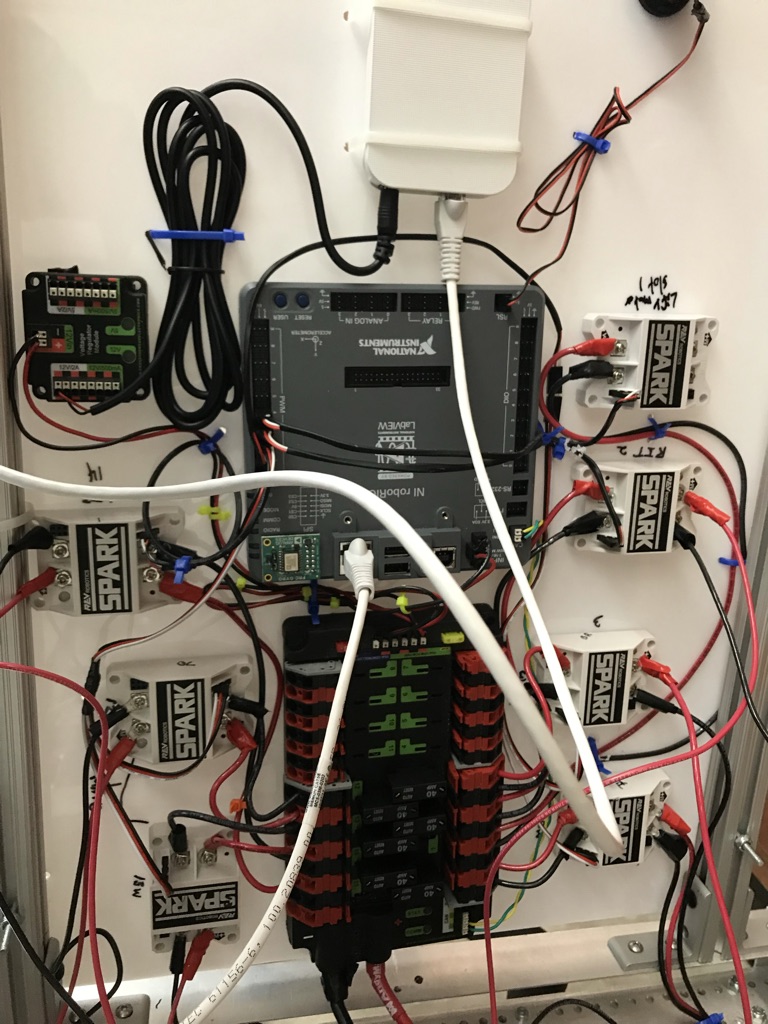
After years of becoming a software engineer, I found myself back where I started, except I no longer wanted to own only the code.
And I no longer wanted to build a robot simply because building one was interesting.
I’ve spoken with people who rely on paid help for things like moving objects around the house, cleaning, organizing, or doing laundry. I have heard people describe leaving home and later wondering whether they actually turned off the stove. These are mundane problems until enough of them accumulate that living independently starts to depend on somebody else being available.
If we solve for helping elderly people remain independent in the home, we will have built something useful for nearly everyone.
Laundry is an interesting place to start. Clothes give us a large and varied manipulation problem, and almost nobody would object to getting the time spent folding them back. But laundry is not the point.
We have spent decades building machines that help us get more out of human labor. I am more interested in what happens when machines begin removing labor that no longer needs to be ours.
I do not want the end state of AI to be measured only by how much more productive a company can make one person. If AI makes us dramatically more productive, but ordinary people still spend their limited healthy years doing work machines could have taken from them, then we aimed too low.
Someone who spent forty years giving to society should not lose the choice to live independently because carrying something heavy, keeping up with laundry, or managing the house has become too difficult.
At fifteen, the robot I wanted to build was something I could drive around with a joystick.
The one I want to build now should give someone part of their day, or their independence, back.